Judith Parrott
Introduction
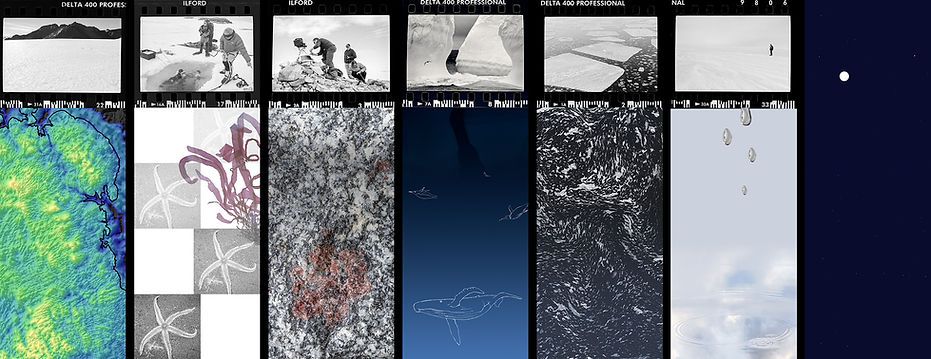
Antarctic ice plays a crucial role in climate regulation, powering ocean currents, and as feeding habitat for keystone species. What lies beneath the ice helps scientists understand how Antarctica, and the world, will respond to climate change. “The Frieze” looks at the increased urgency of climate action and the significance of the melting ice, in the twenty years since my Australian Antarctic Division Arts Fellowship. Taking digital photographs of film negatives obtained during the Fellowship, manipulating new photographs, photographing recent drawings, and using mapped subglacial topography, provided with permission of Dr Helen Ockenden, 2026, I consider what lies beneath the ice in this new series. Using my phone as backlight, suspending the negatives above it, I digitally photographed and inverted the film to positives. The strip format references negative film, in the manner of the original exhibition. The bottom strip depicts what lies beneath the surface. Together the series invites conversation on Antarctic ice and one of the fastest-warming places on Earth.
The Frieze
Antarctica, the world's largest desert, is 99.5% covered with ice, storing 70% of Earth's freshwater. Seven panels, arranged as a frieze, reveal the continent's hidden topography and depict ice as climate regulator, driver of ocean currents, and supporter of vast ecosystems. If all that ice, held frozen in place for millions of years, melts to water, the results would be catastrophic for the human race. I recently listened to a BBC Ideas podcast by science journalist Alok Jha, about the wonders of water. The idea that the same water that exists inside us has been, “recycled inside dinosaurs, bacteria, the oceans, storms clouds, the polar ice caps and much more,” really resonated. That this water inside us started life on asteroids and comets from space seems even more profound. Even if only through this water, we must be intimately connected to our planet and landscapes. And to the ice of Antarctica.
Panel 1: Mount Henderson
Mount Henderson (970m) is mostly covered by the Antarctic Ice Sheet. Crossing the ice in our approach to climb Mount Henderson, it was impossible to know what lay beneath the surface. The mapped subglacial topography, provided with permission of Dr Helen Ockenden, 2026, uses new techniques compiling six decades of geophysical data and satellite observations to reveal previously unknown landforms: high-relief alpine valleys and deeply eroded ice stream troughs. These maps are not only a fascinating view of the topography below the ice, but will also help to refine projections of ice loss and sea level rise.
Panel 2: Ice Dive
Scientists use tiles to monitor seafloor ecosystems beneath the ice. There is significant biodiversity found in the cold waters of Antarctica. The unique, dark ecosystems under the ice face catastrophic changes. Understanding them also helps in the understanding of how deep-sea life will change as the planet warms.
Panel 3: Moraine
Ice carries rocks from central Antarctica to the coastal moraine. Moraines, where we collected these garnets, reveal 2.5 thousand-million-year-old rocks, from landscapes buried beneath the ice for millions of years. The rocks help scientists understand the hidden geology below the East Antarctic Ice Sheet; the largest icesheet in the world.
Panel 4: The Southern Ocean
Icebergs that calve from the Antarctic ice shelf and float out to sea, trap land nutrients that are typically supplied by river estuaries but otherwise lacking in the seas around Antarctica. As the iceberg melts, these nutrients are released to the sea, increasing marine life beyond a 3 km radius of the iceberg. The nutrients significantly increase phytoplankton blooms that support krill, fish, penguins, and whales. Phytoplankton blooms also absorb carbon dioxide from the atmosphere. When they die, they sink to the seafloor, trapping carbon in deep-sea sediments and acting as a carbon sink. Most of an iceberg’s mass is hidden below the surface of the water. It is just the tips that we can see.
Panel 5: Ocean Currents
As Antarctic sea-ice freezes it goes through many stages: Frazil, grease ice, nilas, pancake ice, young ice, first year ice and old ice. During this process, salt is expelled, creating dense water that sinks to become Antarctic Bottom Water. This water displacement, caused by the falling denser water, drives global ocean currents. Inspired by NASA satellite data depicting these currents as akin to a van Gogh sky, I manipulated my sea-ice photograph into a piece representing this vital ocean circulation process.
Panel 6: The Melt
The Antarctic ice sheet contains 70% of Earth’s fresh water, with depths reaching 4.8km. Scientists warn that if this entire ice mass melted, global sea levels would rise by approximately 58 meters, causing catastrophic changes. Moreover, existing Antarctic ice reflects up to 90% of solar radiation back to space.
Panel 7: The Stars, Water and Us
Up to 60% of the human adult body is water. That water inside us has been recycled through dinosaurs, bacteria, the oceans, storms clouds, and the polar ice caps. All water started its life on asteroids and comets from space and the ancient, constant water cycle means we are intimately connected to our planet and to the space surrounding it. Understanding our own intrinsic link to water and ice may be key to helping us understand our role in the planet’s survival.